This Is Not a John Henry Story
Nobody can change it on you.
a conversation with 0xDEAFBEEF
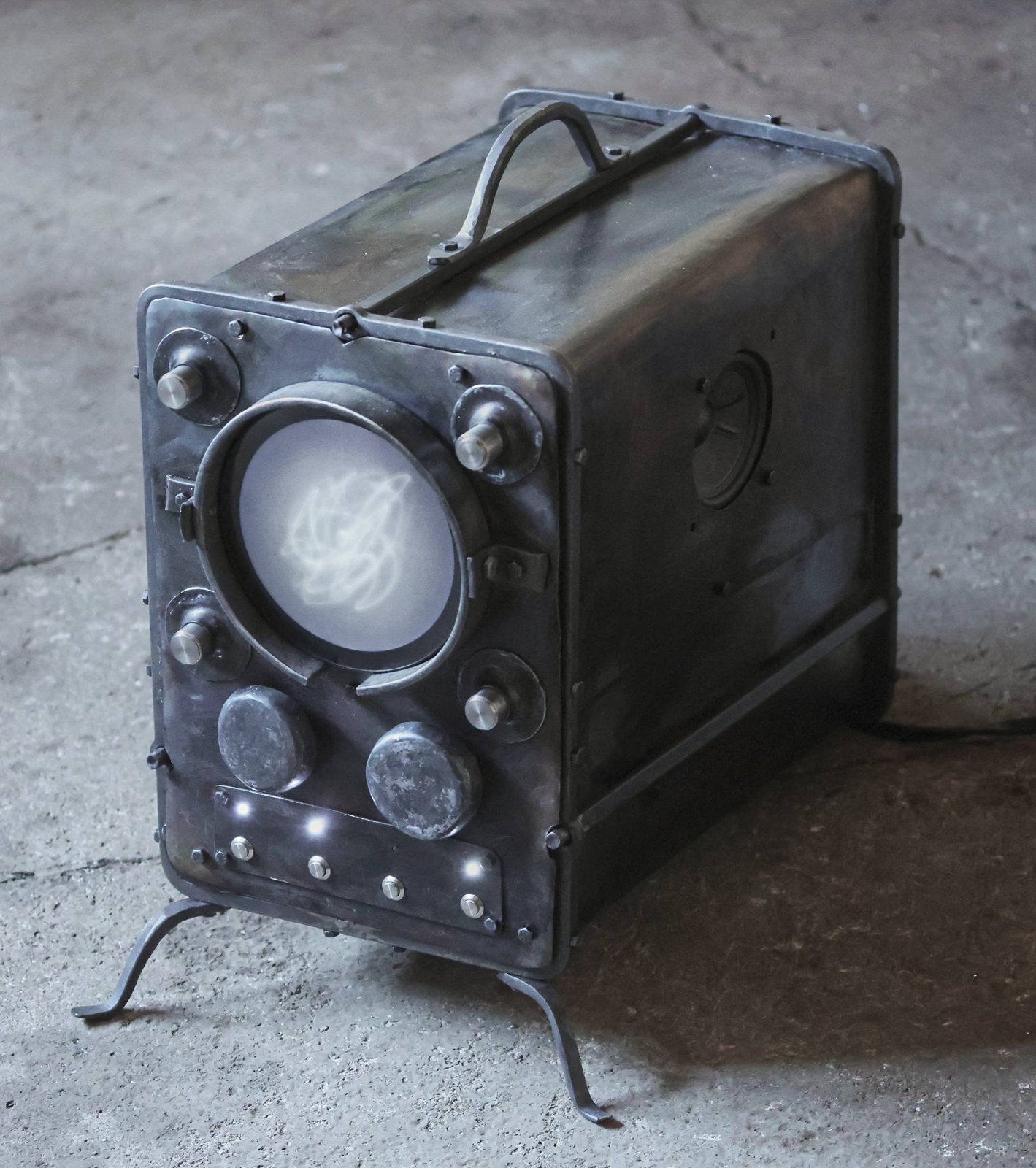
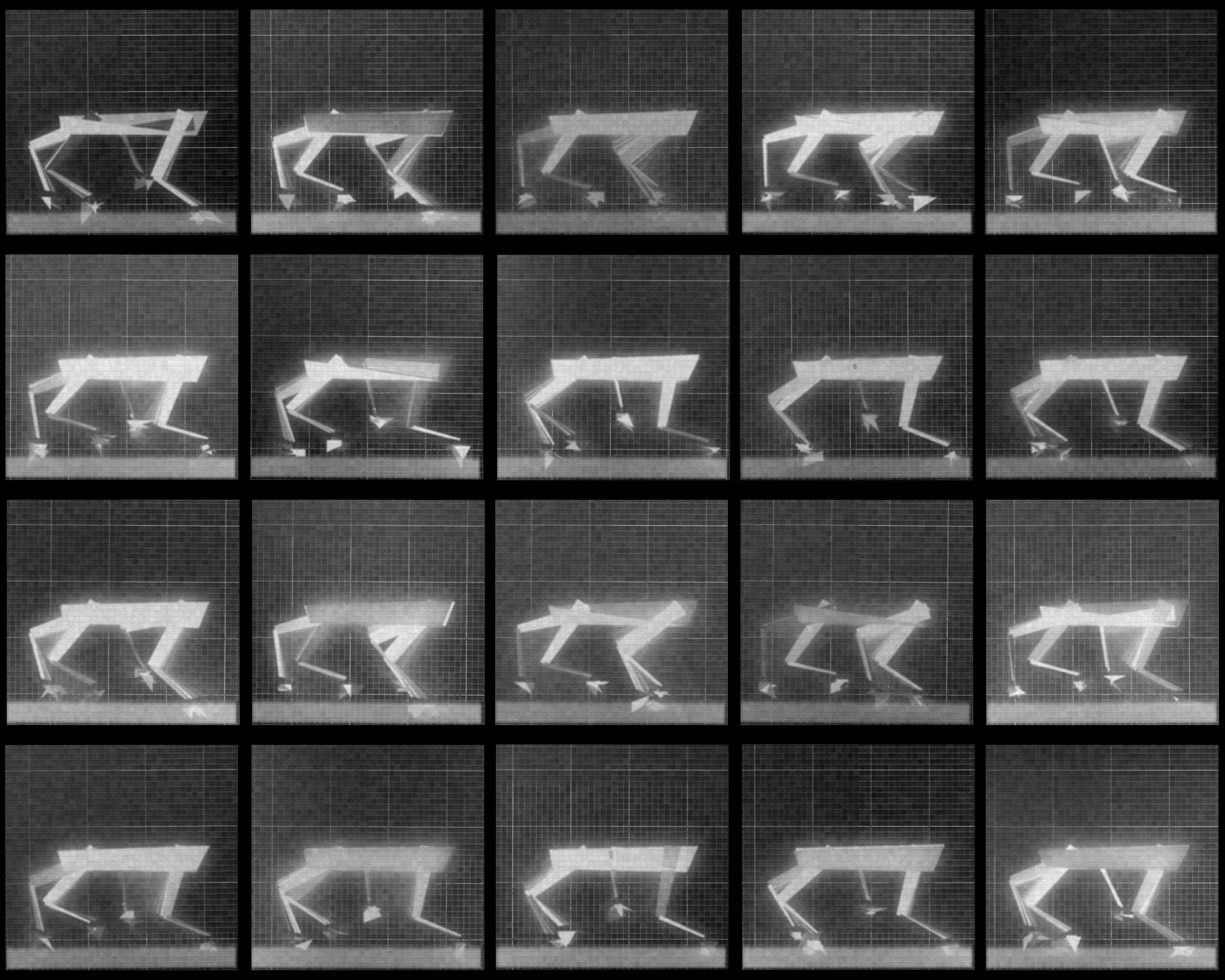
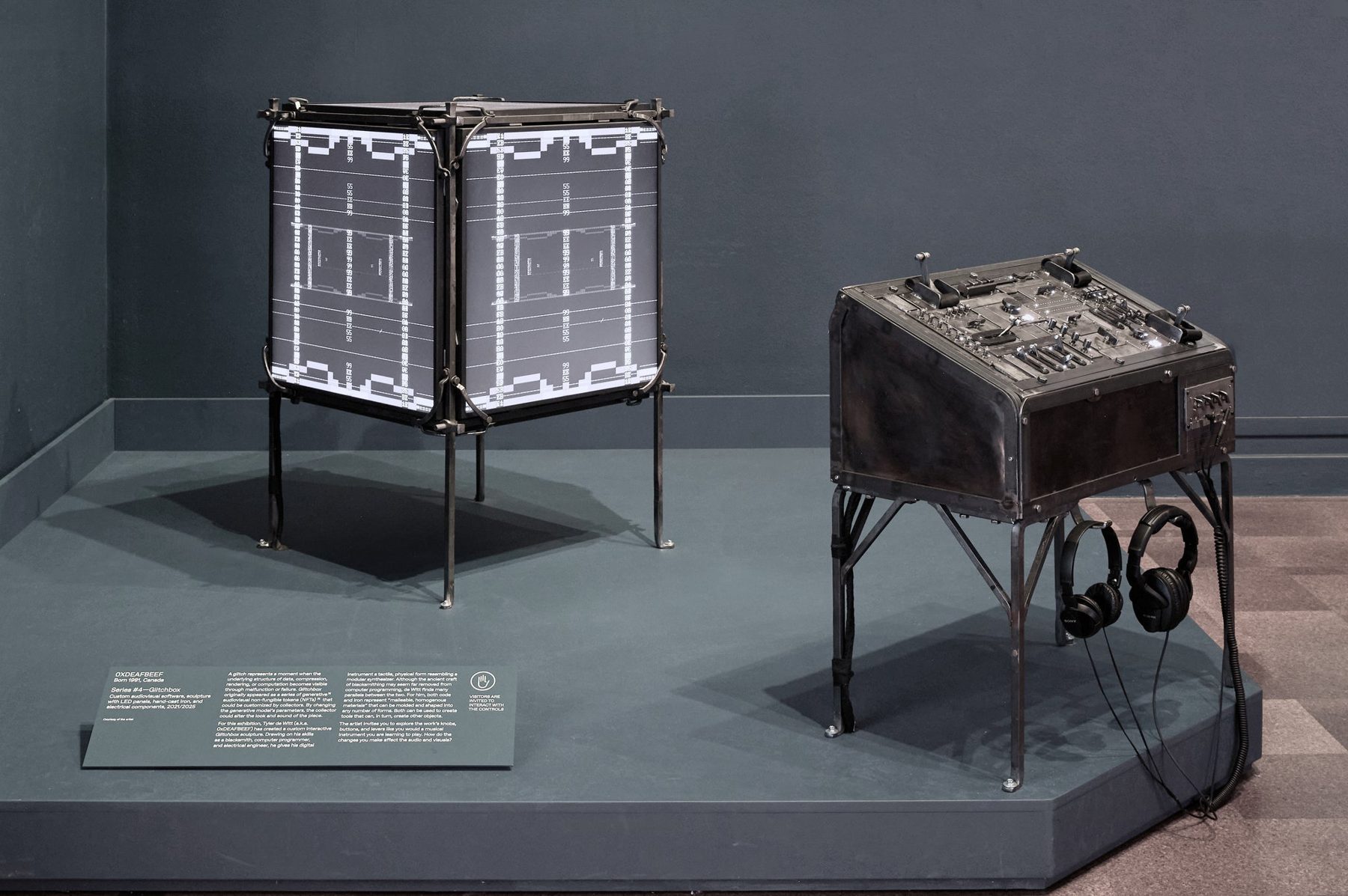
He is the only artist at the fair who arrived by way of a forge. While the main hall fills with crates and right-angled booths, the digital section — set apart in the park building, its works at angles, with room to breathe — has a man standing among oscilloscope sculptures he machined himself. There is a Glitchbox you can touch. Framed chronophotographs. A row of leather objects, six remaining. Avery Singer is next door.
He writes his art in C, the bare language, and between commits he hammers metal in a workshop ten meters from his kitchen — because, he says, if it were a ten-minute drive he would never go.
We have been in the same room three times in five years: New York in 2022, on a panel about time-based media; Patagonia in 2023, for Hashmarks; Basel now. He travels even less than I do. He came for this.
I brought questions. He decided what to do with them.
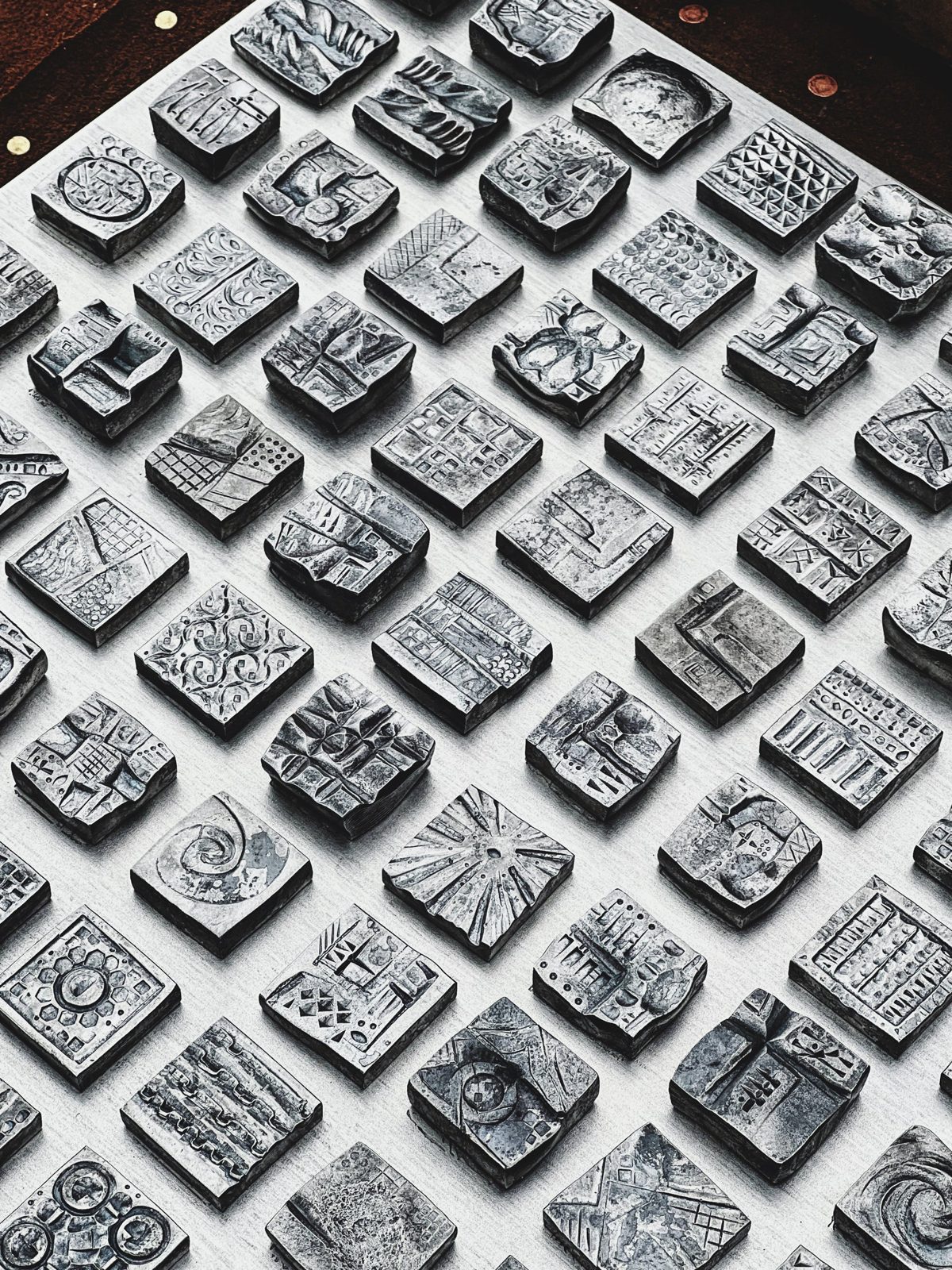
The through-line is a boulder in Patagonia. Before we shared a stage, we shared a rock — June 2023, the first Bright Moments expedition to El Calafate, where I walked out onto the steppe and found the glacial erratic that sites 0xDEAFBEEF’s Hashmarks: a hundred hand-forged talismans, each cryptographically tied to an encrypted token on-chain, the key engraved in the iron.
I. The Spike-Driver’s Refusal
I started where everyone wants to: with the threat. His whole practice is about reclaiming agency, anchoring against acceleration — and AI is the acceleration. I asked whether it was the tide he builds against.
I don’t see it as something I’m working against. It changes the conditions — the same actions you’d have done before now mean something different in the era of generative AI. Craft means something different. This is not a John Henry story. The man who hammered the railroad spikes by hand, raced the machine, and lost. It’s not that.
He won’t take the part. He isn’t against any of it — he has made protocol art, used computers, made work about AI. He’s interested in craft for other reasons. He isn’t mourning the hand; he’s relocating what the hand was ever for. Ask him whether prompting could be a craft, and:
Craft is a connection to tradition, to cultural history. There’s a political dimension. If you’re prompting a model that can be taken away from you — alienated, switched off by someone else — that cuts against it. The version that would be craft is the open model, run locally. Think of the Arts and Crafts movement as a reaction to the Industrial Revolution. The agency you have from knowing how to make something with your hands — that can’t be taken from you. It connects you to your region, the person who taught you, the person who taught them. Prompting doesn’t map onto that yet.
There it is, the thing the whole conversation turns on: that can’t be taken from you.
II. What Can’t Be Taken
It is why he writes in a language from 1972 and forges iron in his garage — not nostalgia, though there’s that too, but sovereignty. He is, before anything, a systems thinker: he chooses systems he can hold end to end, every rule visible. He’s even particular about the word — a generative algorithm you run a thousand times isn’t really a protocol, he’ll tell you; a jazz score is, because the player has to interpret it. But under all of it is one instinct — ownership.
Nobody can change it on you. I started the deafbeef work because software just kept changing — my audio projects from 2005 don’t run anymore, and I didn’t want to live in that quicksand. It’s enough to have a scaled-down, self-contained world that’s sovereign to me. I can leave for two years to look after a newborn, come back, and everything still works. I don’t have to reboot my anvil.
He is the one who helped write CryptoPunks onto the chain in 2021 — compressing the data so the image itself, not just a hash of it, could live there. So I asked what permanence actually means to him.
It’s more about the desire for permanence. The idea of the blockchain as an immutable source of truth that lasts for eternity — that says a lot about humans. It’s seductive, it’s interesting. I don’t think it really works out that way in practice.
The week we spoke, the abstraction turned concrete. A frontier model I’d been living inside had just been pulled out from under me by an export-control order. So I put it to him plainly: what does it mean when the most magical tools can simply be yanked?
You can get rugged by the US government over a closed model housed somewhere else. If I were going to work with these things, I’d want open-source models, run locally. That’s the ethos — and the community — I’d be interested in.
Open source, the deterministic on-chain work, the forge: one instinct in three materials. You can’t get rugged by a thing you wholly own.
III. The Last Refuge
So is the body the point — iron, the bare machine, the hand? I asked whether he’d want an extra one: an exoskeleton, an extra thumb, something to augment the practice. He waved it off.
It’d be fun to try. But do I desire an exoskeleton? We’re already cyborgs, for all practical purposes. Me building a power hammer in my garage to work metal isn’t really different from any of the other ways we’re already wired into our machines. Stiegler wrote about this. “Now I have an extra finger” is almost a gimmick — look, now we’re cyborgs. No. We’re already cyborgs. You’re already scrolling your phone constantly. We’ve been enmeshed with technology since we’ve been human. That’s what made us human in the first place.
The interchangeability argument — that a machine doing the thing better dissolves the reason to do it — he files under first-wave cybernetics, and rejects on the only ground that holds:
Just because a machine can do something better than me doesn’t change that I want the experience of doing it. That, in itself, answers the question.
And if the experience is the irreducible thing, the question becomes which of the senses can’t be counterfeited. His answer is specific: touch.
You can’t fool your tactile senses with technology, yet you can easily fool sight and hearing — perfect 4K, VR. The interfaces for touch are extremely crude, and will stay crude until there’s a brain implant. There’s no in-between. So tactility is almost resistant to virtuality. There’s a Czech stop-motion animator, Jan Švankmajer, banned by the communist government in the ’80s — so he researched tactile art and wrote a book about it. Intensely political. His view: our visual and auditory senses have been dulled, colonized by mass media, and the tactile dimension is the last refuge.
This is the argument under the Glitchbox you can touch, under the oscilloscope sculptures you tune like a radio, under the whole quiet boom in cyberdecks and single-purpose tactile machines — devices people build and soup up themselves, from communities you’d never stereotype as tech. What drives it, he says, is exactly people’s feelings about their relationship to the machine. People want to feel.
It is the argument made in iron, too. We carried the hundred Hashmarks to that glacial erratic in Patagonia, laid them out in a grid, and everyone took one to the far corners of the earth — the only time they will ever be in one place.
It’s a one-way process through time. The erratic is never going back; we were all there together, and we’ll never be in that state again. A hash is easy to compute forward and impossible to reverse — that one-way trapdoor is the whole reason a blockchain can exist at all. And the weight of the iron — that, you can feel.
IV. Art Is Social
Then the turn — the one that, for me, is the reason to publish this at all. He has a working model of what art even is, and it has nothing to do with objects.
There’s nothing inherent in the object — a painted canvas, whatever — that has meaning on its own. The only meaning is what we attach within relationships, ultimately with other people. To a neutral observer watching Earth from outside, it’s all just chemical reactions; there’s no meaning. We create that. So you can make art with anything — it doesn’t have to be certain materials.
It came, he tells me, from rings — non-precious metal, simple forged bands he used to make.
You could buy a titanium ring on Amazon for twenty bucks. But people would write me thank-you letters. The intangible part: made by Canadian blacksmiths, hammered, here’s the evidence it’s unique. That prepared me for NFTs. The ring isn’t about the atoms of the ring. It’s the context. Why do we get people to go to a rock — the diamond? Same thing.
The ring makes the point cleanly: value was never in the metal. It was in the hand that hammered it, and the person who knew that. It is the inversion I keep meeting in my own work — where the thing you make stops being the point, and the relationships it makes become it — and he had built the proof of it years before I had the word.
V. Is Prompting a Craft?
It was the fight worth having, and the one the room wanted. When I asked for a show of hands, they split clean down the middle. He argued the hard side, generously.
I’m not saying prompting has no skill. But craft, the way Morris and Ruskin meant it in reaction to the Industrial Revolution, has political, social, historical dimensions — traces of those histories are literally visible in worked metal, in textiles, in clay. It’s hard to say prompting has that yet. What’s the history of prompting? How is it critically engaged with those histories? Someone’s going to have to convince me.
I took the other side — that it already is one, closer to poetry, where it isn’t how many words you write but the few you choose, and that it turns political the instant a model is pulled for what it will and won’t say. He held the line on history. Then the room landed the blow neither of us had teed up: John Cage’s instructions. Sol LeWitt’s wall drawings. We’ve been prompting as art for nearly a century.
Point taken.
The room had handed us the lineage; I’d only extend it — prompting and protocol as the live edge of something that runs back through Fluxus, LeWitt, Yoko Ono: the score and its instantiation, the imperative that turns out to be poetic. He’d call it a system. I’d call it a relationship. We were, as he likes to say, agreeing violently.
VI. What’s Yours, and What’s Historic
I asked the closing question — if a work runs forever without you, is it still yours? — expecting something about permanence. He gave me something about release.
It stops being yours much sooner than that. It has to be completed by the audience — those aren’t my words, someone else said that. It becomes something beyond the original intent almost immediately. You don’t need to run forever, you don’t need to be dead. People write songs and the song becomes something else. It gets released into the world and becomes part of culture.
Which is the right note to end a sermon on permanence — except he refuses to let it be a sermon. The fall’s work was stop-motion films that are provably real: he mints the hash of each frame and spells the block hash into the physical material, so he can prove a specific event happened at a specific moment. Balaji’s line — AI makes everything fake, crypto makes it real again — he finds seductive and a little absurd, and the work is the joke told straight.
All I’m proving is that I’m moving junk. That’s the only thing I prove. And it’s historic. It pokes at the grandiose statements about blockchain truth saving us from the breakdown of consensus reality. I get a laugh out of it.
He only began calling himself an artist in 2021, when the NFTs made him justify it; before that, musician, composer, clever technologist, tinkerer. He seems lighter now for having stopped needing the word. He goes into the shop every morning. He’s making embodied machines — generative processes, screens, speakers — and that, he says, will subsist until it morphs. Small things can be potent too. They don’t have to be bigger for the sake of being bigger.
· See the Work — Matter and Signal
0xDEAFBEEF’s Basel exhibition with Asprey Studio — Matter and Signal. Twenty years of merging computation with the forge:
Works courtesy the artist and Asprey Studio. On view at Art Basel — booth Z3, June 16–21, 2026.
- 2021–26 Synth Poems: Oscilloscope — forged iron paired with on-chain generative audiovisual works
- 2021–25 Glitchbox — an interactive forged-iron sculpture you tune by hand
- 2023 Chronophotographs — platinum-palladium prints paired with digital works
- 2023 Hashmarks — hand-forged iron engraved with cryptographic codes; the Patagonia intervention above
- 2022 Self-Titled — 180g vinyl pressing of the 2021 generative audio
Dialogue 01 · Chapter 1 · 0xDEAFBEEF · Basel, 2026 Drawn from two conversations — the evening before, and on stage the next day, at the Digital Art Summit in Basel. Edited and arranged; his words intact.